

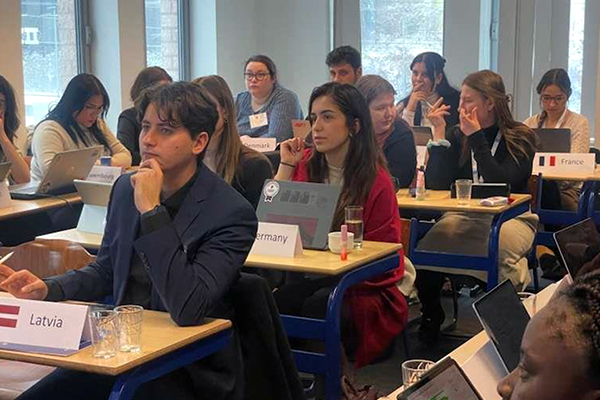
Seven students from SUNY Cortland traveled to Brussels, Belgium in January to participate in the Global Model European Union (GMEU), a diplomatic simulation that brought together more than 120 students from 12 schools across six countries. The students represented various European Union member states and engaged in complex negotiations on contemporary issues including tariffs, cybersecurity, and geopolitical challenges in Ukraine and the Middle East.
The Model European Union conference took place at Vesalius College in Brussels before the start of the spring semester. Participating institutions came from the United States, Belgium, Bulgaria, France, Germany and the United Kingdom, with SUNY Cortland joining four other New York universities at the event, according to Professor of History Scott Moranda.
Students Prepare for Model European Union Simulation
To prepare for the Model European Union experience, Cortland students enrolled in a fall course focused on the European Union. The preparation helped participants better understand the often contradictory needs and priorities of the EU’s diverse member states. Students were assigned specific roles representing different countries and ministerial positions during the simulation.
Layla Myers, a double major in teaching English as a second language and international studies, represented Poland as its prime minister. Meanwhile, Ava Graziano served as prime minister of Denmark, while Maria Fernandez acted as Poland’s foreign minister and Emma Caraher assumed the same role for Denmark.
Additionally, Maddie Houghton and Carly Hammond served as defense ministers for Poland and Portugal respectively. Zach Biemer represented Portugal on the Environmental Council, rounding out the Cortland delegation’s diverse portfolio of positions.
Real-World Events Shape Diplomatic Discussions
The simulation took on added significance as real-time global events unfolded during the conference. According to Moranda, who attended as faculty advisor and mentor, discussions about the invasion of Venezuela and debates about Greenland emerged just before and during the event. Students roleplaying as foreign ministers and heads of government had to respond to these developments in their negotiations.
“Actually putting that research into practice and being able to interact with peers who also dedicated their time to preparing for their roles was extremely enlightening,” Fernandez said. The experience allowed students to apply their academic preparation to realistic diplomatic scenarios.
However, the initial commitment required some convincing for certain participants. Emma Caraher, a triple major in history, anthropology and international studies, admitted she was skeptical at first. “At first, the GMEU looks like a lot of work, but I agreed and I couldn’t be more grateful that I did,” she said.
Building International Relations Skills Through Model EU Experience
Moranda emphasized that the Model European Union simulation offers learning opportunities that cannot be replicated in traditional classroom settings. “While you could technically do it online, it would not be the same as being in the same room with other students from multiple countries learning to compromise, craft proposals and find common ground in real time,” he said.
In contrast to online alternatives, the in-person experience allowed students to develop negotiating skills, test their EU knowledge and gain confidence in public speaking. Alexandru Balas, professor of international studies, noted that Cortland was one of the first universities in the U.S. to participate in Model EU conferences, dating back to 1988 when the event was called the Model European Communities conference.
Beyond the simulation itself, students visited museums, enjoyed a day trip to the city of Bruges and attended guest talks from EU dignitaries. The cultural immersion complemented the diplomatic training, providing a comprehensive European experience.
Support and Future Participation
Moranda credited multiple campus offices for making the trip possible, including the International Programs Office, the School of Arts and Sciences, the President’s Office and the Clark Center for Global Engagement. The current iteration of the GMEU began in 2022, with Cortland making trips for the past three years.
Biemer reflected positively on the networking opportunities and lessons in how countries with different goals find common ground. “I have gained new leadership skills and I look back on the trip with no regrets and would highly do it all over again, as I have felt like I got to embrace a new culture and enjoyed the experience to the fullest,” he said.
The university has not announced whether it will send another delegation to future Model European Union conferences, though the program’s three-year track record suggests continued participation remains likely.