

Sleep is a strange product to sell. Airlines have been offering legroom, meal upgrades, lounge access, and even the opportunity to board a few minutes early for decades. However, renting a horizontal surface in economy class by the hour feels completely different. The airline industry’s most literal attempt to place a price on rest is Air New Zealand’s Skynest, which will finally arrive on its New York to Auckland route in November.
The figures are simple and somewhat shocking. In addition to a one-way economy fare that already approaches US$900, a four-hour session in one of six lie-flat pods will cost NZ$495, or about US$292. The pods themselves are stacked three high on each side of a tiny cabin nestled between economy and premium economy. They are narrow, measuring roughly 64 centimeters at the shoulder and tapering to 41 at the feet. Inside one, you can’t sit up. You are unable to eat. The airline drily observes that a child cannot be smuggled in.
| Subject | Details |
|---|---|
| Product | Economy Skynest™ |
| Operator | Air New Zealand |
| Chief Executive | Nikhil Ravishankar |
| Aircraft | Boeing 787-9 Dreamliner (V5 configuration) |
| Cabin Location | Between Premium Economy and Economy |
| Number of Pods | Six per aircraft, stacked in two columns of three |
| Pod Dimensions | 203 cm long, 64 cm wide at shoulder, tapering to 41 cm at feet |
| Session Length | Four hours, one session per passenger per flight |
| Price | NZ$495 (approx. US$292 / £215) per session |
| Inaugural Route | New York JFK to Auckland, 17 hours |
| On Sale | 18 May 2026 |
| First Flights | November 2026 |
| Eligibility | Economy and Premium Economy passengers, age 15+ |
| Inclusions | Mattress, fresh bedding, privacy curtain, reading light, charging port, amenity kit |
| Concept First Announced | 2020 |
It seems like Air New Zealand has been holding off on doing this for a while. The idea was first proposed in 2020, discreetly put on hold, piloted in late 2024, and now, six years after the initial announcement, has a launch date. Since then, long-haul flying has evolved. The airline suspended its full-year earnings outlook in March, fuel prices have remained unstable, and in April, about 4% of its flights were cut. There is clear appeal to selling a new product to economy travelers that doesn’t require creating a completely new cabin class.
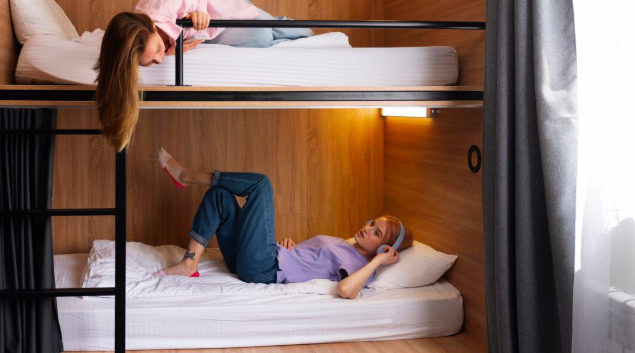
It’s easy to overlook how fascinating the economics are. Twelve reservations for six pods, two sessions per flight, cost NZ$495 each. Before accounting for laundry, amenity kits, and the time spent by cabin crew changing pillows between sessions, that amounts to about NZ$5,940 in extra revenue per flight. For an airline, it’s not transformative money. However, the math that airline executives find most convincing is the revenue that is extracted from floor space that had previously produced nothing.
However, the framing is what makes Skynest culturally intriguing. The published guidelines from Air New Zealand are more akin to a passive-aggressive note left on a roommate’s refrigerator than they are to aviation policy. They remind passengers that “not everyone dreams in vanilla-sandalwood-cloud-musk,” advise them to “go easy on perfumes and potions,” and reassure them that snoring is statistically inevitable but will not be frowned upon. Although it’s a minor detail, it provides insight into the airline’s target market. Not the business traveler, who has a flat bed up front already. Not the low-cost traveler who will use a duffel bag to sleep upright. Someone in the middle, willing, solvent, and exhausted.
Other carriers are keeping a close eye on things. According to reports, United is working on a triple-seat couch conversion for 2027. On its Sydney–London Project Sunrise route, Qantas intends to establish a wellness area starting in June. The trend suggests that airlines are selling temporary access to already-existing space because they are running out of ways to sell premium space. It remains to be seen if travelers will pay $495 for four hours of horizontal time on top of an already costly ticket. As this happens, it’s difficult to avoid wondering if sleep has just become the next thing to unbundle, much like baggage and seat selection before it.