

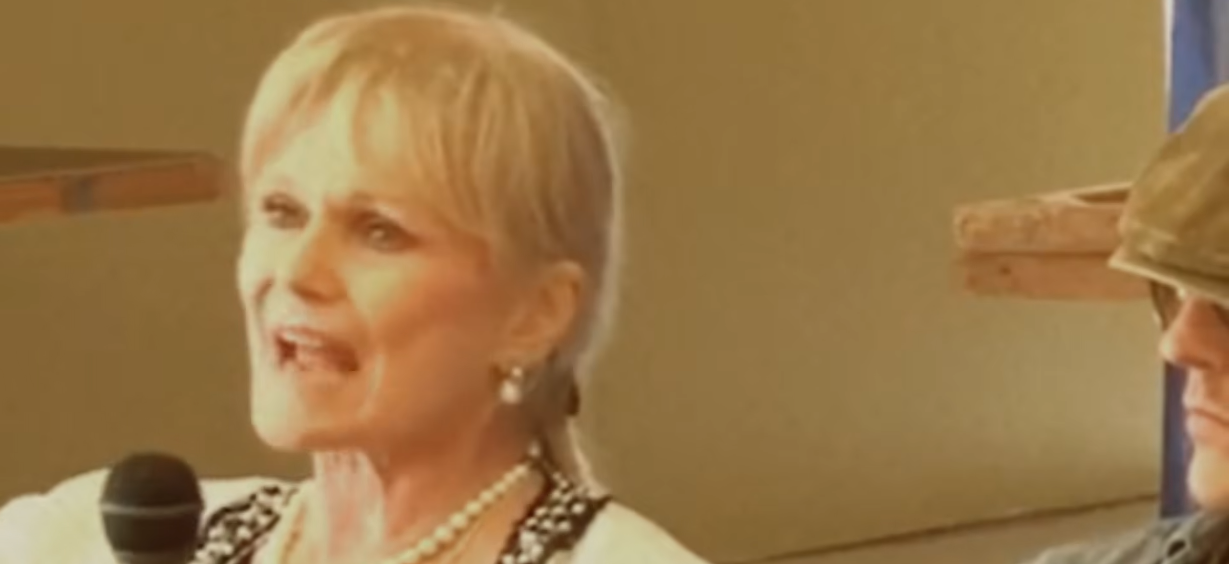
Hollywood never quite knows what to do with a certain type of actress: the woman who is unquestionably gorgeous and, almost in spite of that, incredibly talented. That actress was Valerie Perrine. On March 23, 2026, she passed away at her Beverly Hills, California, home. She was eighty-two. Parkinson’s disease complications, which she had been dealing with since 2015, were the cause of death. Stacey Souther, a close friend and caregiver who had also chronicled Perrine’s last years in a short film that was shown at the 2020 Edmonton Film Festival, confirmed her death.
The news came quietly, as it usually does when a career ends rather than an era. Unlike her contemporaries Faye Dunaway and Jane Fonda, Perrine was never as well-known. However, there are two or three of her contributions to cinema in the 1970s that are truly priceless.
| Field | Details |
|---|---|
| Full Name | Valerie Ritchie Perrine |
| Date of Birth | September 3, 1943 |
| Place of Birth | Galveston, Texas, USA |
| Date of Death | March 23, 2026 |
| Place of Death | Beverly Hills, California, USA |
| Age at Death | 82 |
| Cause of Death | Complications from Parkinson’s disease |
| Nationality | American |
| Profession | Actress, former showgirl |
| Notable Films | Lenny (1974), Superman (1978), Superman II (1980), Slaughterhouse-Five (1972) |
| Awards | Best Actress – Cannes Film Festival (1975); BAFTA Most Promising Newcomer |
| Academy Award Nomination | Best Actress for Lenny (1975) |
| Diagnosed with Parkinson’s | 2015 |
| Survivors | Brother Ken Perrine; close friend and caregiver Stacey Souther |
| Reference | Wikipedia – Valerie Perrine |
The scene in Lenny where she breaks down, fragile and furious at once. She swims down to save a drowning Man of Steel in Superman because she just cannot allow someone to perish, not even to appease the man she loves. Maybe little moments. But those who stick by you.
She was born on September 3, 1943, in Galveston, Texas, and moved around a lot as a child. The family traveled from Texas to Japan to Arizona and back thanks to her father, a lieutenant colonel in the U.S. Army. That kind of rootless upbringing—constantly observing, constantly acclimating to new spaces and people—may have given her something that an acting school could never have. After graduating from Phoenix’s Camelback High School, she briefly attended the University of Arizona before moving to Las Vegas, where she began working as a showgirl at the Stardust Resort and Casino in 1968. Hollywood was not part of her plan, no matter how she envisioned her life.
She didn’t go into acting. She was almost ridiculously discovered by acting at a dinner party. When an agent noticed her across the table, he concluded that she was perfect for the part of Montana Wildhack in the 1972 movie adaptation of Kurt Vonnegut’s Slaughterhouse-Five. She entered the set without taking any lessons, and she more than held her own. Her best work never felt performed at all, which may be explained by the feeling that she always performed on instinct rather than technique.
Two years later, the true breakthrough was made. In the film Lenny, Bob Fosse cast her as Honey Bruce, the spouse of Dustin Hoffman’s explosive, boundary-pushing comedian Lenny Bruce.
The long-suffering woman standing next to the challenging genius was a role that could have easily been decorative. That was not how Perrine would play it. She won the Best Actress Award at Cannes and was nominated for an Academy Award, but she ultimately lost to Ellen Burstyn because of the unvarnished quality she brought to Honey. The loss still hurts a little when I watch that performance now. It was truly devastating.
In 1978, she played Eve Teschmacher in Richard Donner’s Superman, trading jokes with Gene Hackman’s Lex Luthor while sporting a red dress. The part could have been as simple as a prop or sidekick. Rather, Perrine made Eve one of the most sympathetic characters in the movie—a woman who is aware that she is on the wrong side of things but finds it difficult to convince herself to stay there. In 1980, she returned to the role in Superman II, and even though it required less of her, she gave it her all.
As was common for women in that field once they reached a certain age, her career in the 1980s became uneven. She accepted smaller roles, TV guest appearances, and the odd cult hit like Can’t Stop the Music. She appeared on ER and Nash Bridges, costarred with Jack Nicholson in The Border, and never seemed to stop working. She had not moved on from the industry, but it had moved on from her.
The Parkinson’s diagnosis in 2015 makes it difficult to avoid feeling especially depressed. The illness is cruel in certain ways, such as taking away physical control and depriving an actor of their most important tool. In the short film Valerie, which debuted in Edmonton, Souther—who went on to become both her caregiver and documentarian—captured a portion of that final phase. From a woman who had spent decades being seen but never fully understood, it was a rare moment of candor.
Parkinson’s disease complications are Valerie Perrine’s cause of death, which is a clinical term for something that required eleven years of perseverance. Souther and her brother Ken survive her. She leaves behind a few performances that serve as a reminder of what screen presence truly entails: the subtle, unmistakable sense that the person in front of the camera is utterly genuine, rather than loudness or spectacle.