

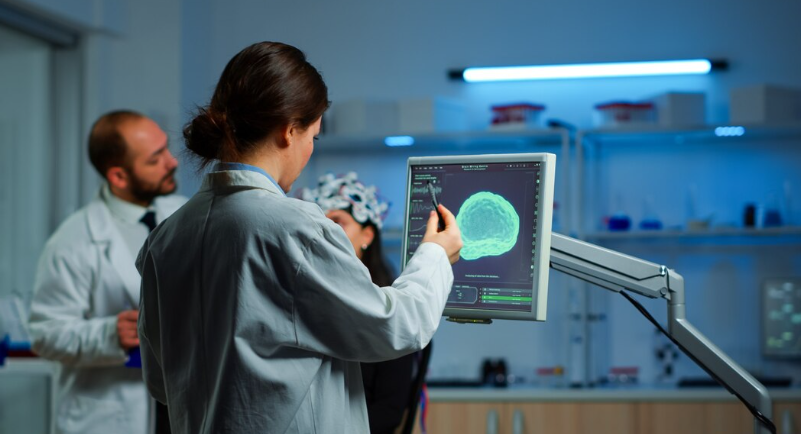
A team of researchers saw something strange occur in a dimly lit lab in Heidelberg, where screens glow with moving neural patterns and microscopes hum softly. Brain cells that were supposed to die did not.
It appeared to be a small anomaly at first. Experiments consistently fail. Cells exhibit erratic behavior. However, the moment started to feel different as the data accumulated—repeating the same pattern repeatedly. There was more going on here.
| Category | Details |
|---|---|
| Topic | Neurodegenerative Disease Breakthrough |
| Key Diseases | Alzheimer’s, Parkinson’s, ALS |
| Core Discovery | Blocking cell death pathways in neurons |
| Key Mechanism | NMDAR/TRPM4 “death complex” |
| Breakthrough Tool | Experimental molecule (e.g., FP802) |
| Research Focus | Preventing neuron death rather than symptoms |
| Key Institutions | Heidelberg University, WEHI (Australia) |
| Scientific Shift | From amyloid removal to cell survival |
| Current Stage | Preclinical (animal studies) |
| Reference | https://www.sciencedaily.com |
Neurodegenerative illnesses like Parkinson’s and Alzheimer’s have carried a sense of silent inevitability for decades. The trajectory was known once the diagnosis was made. gradual decrease. Fading memories. stiffening of movement. There were treatments, but they primarily addressed symptoms rather than preventing the underlying damage.
This new field of study adopts a more straightforward methodology. It focuses on what kills the cells rather than what builds up in the brain, such as amyloid plaques. That change is important.
Researchers have discovered what some refer to as a “death switch”—a poisonous protein interaction that causes cell death—inside neurons. In particular, when specific receptors interact in the wrong way, they create a complex that damages the cell from the inside out, interfering with its energy systems and ultimately causing it to collapse.
It sounds technical. In actuality, however, the concept is nearly stark in its simplicity: the cell survives if the trigger is stopped.
Researchers employed a tiny molecule intended to disrupt this detrimental interaction in controlled experiments. The outcomes were remarkable, at least in animal models. The brain’s cells held together. The loss of memory slowed. Even the accumulation of dangerous proteins seemed to decline.
It’s difficult to ignore how different this feels from earlier methods. Cleaning up the brain—removing plaques, lowering inflammation, and controlling symptoms—has been the main focus for years. According to this research, the true struggle might be taking place earlier, when a cell chooses whether to survive or perish. This reframing seems to have been quietly developing over time.
Back in Australia, a different group of researchers discovered compounds that could completely prevent programmed cell death by focusing on proteins like BAX that serve as cell executioners. For years, there has been speculation that neuron death could be stopped, postponed, or even avoided. However, it appears to be coming together into something more tangible only now. Skepticism persists, though. It always does.
Humans are not animal models. During clinical trials, promising results have a long history of disappearing. Whether these molecules can be administered safely, whether they will function similarly in a more complex human brain, and whether unforeseen consequences might occur are still unknowns. However, as this develops, researchers’ tone has subtly changed. fewer resignations. More cautious hope.
This story also has a second, less obvious, but no less significant thread. Scientists can now view the brain in previously unattainable ways thanks to developments in imaging technology. In certain investigations, scientists have monitored how neurons change during learning, observing structures grow and shrink in real time. These findings also suggest that the brain is dynamic. It is continuously responding, rewiring, and adjusting.
Neurodegenerative diseases may be caused by imbalances—systems that are no longer able to properly regulate themselves—rather than just damage. If that’s the case, the emphasis might shift from replacing those systems to their restoration. This has wider implications that go beyond the field of medicine.
As the population ages, neurodegenerative diseases are becoming more prevalent. Families rearranging their lives around care, healthcare systems bearing long-term costs, and societies subtly adjusting to an increasing burden are just a few examples of the massive emotional and financial toll.
Pharmaceutical companies and investors are keeping a close eye on this. There’s a feeling that a true breakthrough—something that slows or stops advancement—would change entire industries, not just medicine.
However, the timetable is still unclear. Even the participating researchers exercise caution. They talk about early steps, pathways, and potential. It will still be years before there are any clinical applications. Maybe longer.
However, it’s hard not to notice that something has changed when you stand in those labs and observe neurons surviving where they would have died. Not a remedy. Not just yet. However, a direction.
For the first time in a long time, it seems that managing decline is no longer the only aspect of the fight against neurodegenerative disease. The idea is to disrupt it, silently, at the cellular level, before it has a chance to fully establish itself.
It remains to be seen if that promise will be fulfilled. However, this question differs from the previous one.