

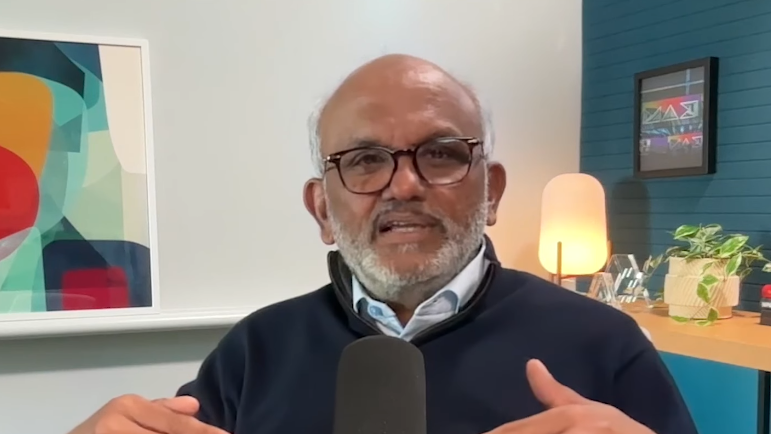
Leadership narratives in Silicon Valley frequently take place in loud, dramatic outbursts. Venture capital moves swiftly, founders show up wearing hoodies, and businesses either take off or disappear. Shantanu Narayen’s career has never quite adhered to that plan. His story progressed more slowly, steadily, and almost silently, but it is hard to overlook the effect on Adobe.
It feels more like a creative workshop than a tech startup when you stroll through Adobe’s San Jose headquarters. Designers using notebooks to sketch. On big screens, engineers examine code. Photoshop artwork posters are displayed on office walls. It serves as a reminder that Adobe’s reputation was established by the tools people use to create things, not by social media or technology.
| Category | Information |
|---|---|
| Name | Shantanu Narayen |
| Role | Chairman and CEO of Adobe |
| Born | May 27, 1963 |
| Birthplace | Hyderabad, India |
| Education | Osmania University, Bowling Green State University, UC Berkeley |
| Became Adobe CEO | 2007 |
| Tenure | Nearly 18 years as CEO |
| Major Achievement | Shifted Adobe to Creative Cloud subscription model |
| Company | Adobe Inc. |
| Headquarters | San Jose, California |
| Reference | https://news.adobe.com |
Long before Narayen was appointed CEO in 2007, that reality was in place. However, if he hadn’t made a contentious move over ten years ago that initially alarmed many investors, the company might look very different today.
Adobe used to sell software in boxes. Photoshop was bought once, installed on a computer, and used for years by designers. The model was cozy. predictable. However, Narayen encouraged the business to focus on subscriptions, which led to the creation of Creative Cloud. Many users voiced their grievances loudly on the internet at the time. It seemed odd to pay for software on a monthly basis.
It feels almost nostalgic to watch those early responses now. The tactic was successful. Adobe’s subscription business model transformed sporadic software sales into consistent recurring income. Investors who were skeptical of the move eventually witnessed a quarterly increase in the numbers.
It seems that Narayen had a better understanding of software’s future than many of its rivals. Similar subscription models for Office and cloud services were later adopted by companies such as Microsoft. Although few executives get the credit they deserve for the idea, the entire industry changed in that direction.
However, software subscriptions weren’t the only aspect of Adobe’s story under Narayen. Under his direction, the business grew into digital marketing and analytics, acquiring companies like Omniture and creating a vast enterprise platform. That action subtly altered how companies monitor online activity.
Marketing executives now talk about “Adobe Experience Cloud” at conferences in Las Vegas and London with the same familiarity that designers used to reserve for Photoshop. It’s a completely different audience. And possibly a more profitable one.
However, Narayen’s last years on the job come at a challenging time for the business. Creative tools are changing due to artificial intelligence in ways that are both exciting and unsettling. These days, generative AI can create layouts, create images, and even compose marketing copy in a matter of seconds.
Regarding the implications for Adobe, investors appear to be divided. Some people think the company has an advantage because of its vast network of creators. Some question whether new AI startups could undermine its hegemony.
The discussion recently became more heated after Adobe’s stock fell precipitously in the wake of earnings reports and general concerns about AI disruption. Observing the market response, it appears that while investors respect Adobe’s prior successes, they are unsure about the company’s future.
Then it was revealed that Narayen would resign as CEO as soon as a replacement was selected, but he would continue to serve as chairman. The choice carries a quiet weight after almost 20 years as the company’s leader.
It’s difficult to ignore how uncommon these lengthy leadership positions have become in Silicon Valley. After five or six years, a lot of CEOs rotate out. For eighteen years, Narayen led Adobe.
The company’s stock rose sharply during that period, at one point multiplying several times over. Long-term investors find the change to be astounding. Employees who started working at Adobe in the early 2000s likely perceive the shift as being even more significant.
Narayen’s story has another aspect that is frequently left unsaid. He is a representative of a generation of global technology leaders who transformed Silicon Valley itself. He was born in Hyderabad and received his education in both India and the US. Similar routes were taken by executives like Satya Nadella, who subtly increased their power within some of the biggest corporations in the world.
As this develops, there’s a sense that Narayen’s legacy might extend beyond Adobe’s earnings or stock value. It may also have to do with how technology leadership has changed over the last 20 years, becoming less about charisma and more about patience.
However, there are still subtle uncertainties about Adobe’s future. The number of AI tools is growing quickly. Every week, designers test out new platforms. Some critics even contend that creative software itself might become more straightforward, automated, and user-friendly for novices.
Adobe will have to adjust once more if that occurs.
And maybe that’s the subtle tension that led to Narayen’s departure. After leading the business through one of the largest changes in software history, he departs. However, the next shift—creativity powered by AI—is just getting started.
As the story develops, it seems as though Adobe is in the same position as it was years ago. prosperous. strong. but dealing with yet another technological revolution that has the potential to completely change everything.
This time, the distinction is straightforward. The leader who made it through the previous transition is leaving. Silicon Valley is awaiting the next chapter’s flyer.