

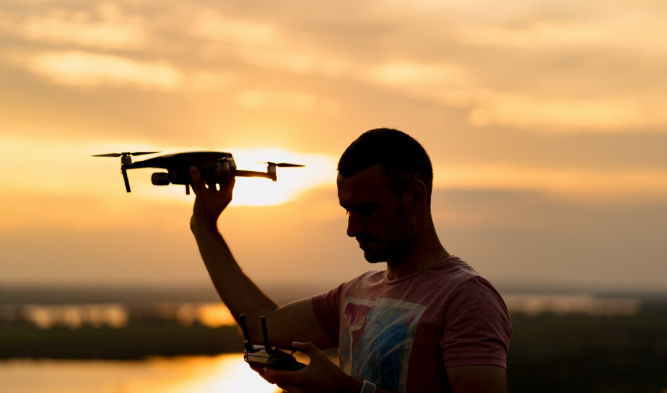
The concept sounded so appealing for years. Before lunch, a package that was ordered in the morning would be gently lowered from the sky by a tiny flying robot that was buzzing over peaceful suburban streets. When Jeff Bezos first presented the idea on television in 2013, it seemed both oddly plausible and a little ridiculous. The way people shop has already been altered by the internet. Why not alter the way packages are delivered?
That bright future appears less certain more than ten years later. In theory, Prime Air, Amazon’s drone program, is still in operation. However, the momentum now feels different. There have been numerous pauses in flights. Test locations are no longer open. Additionally, the skies have become noticeably quieter in the towns where the drones were previously present. The grand promise seems to have collided with the everyday difficulties of the real world.
| Category | Details |
|---|---|
| Company | Amazon.com Inc. |
| Drone Program | Prime Air |
| Founder | Jeff Bezos |
| Program Announced | 2013 |
| Goal | Deliver small packages within 30 minutes |
| Key Drone Model | MK30 autonomous delivery drone |
| Test Locations | College Station (Texas), Tolleson (Arizona), Lockeford (California) |
| Major Challenges | Crashes, regulatory approval, weather issues, community complaints |
| Long-Term Target | 500 million drone deliveries annually by the end of the decade |
| Reference | https://www.amazon.com/primeair |
Residents of College Station, Texas, recall the beginning of the buzz. Mark Smith, a retired engineer, put it in remarkably vivid terms: it’s more like someone operating a leaf blower all day than it is futuristic or elegant. Every few minutes, drones soared above the trees, their rotors slicing through the muggy air of a neighborhood full of backyard pools, gardens, and dogs.
In an effort to mitigate the disruption, Amazon later introduced quieter models. The complaints continued to mount. Parents were concerned that cameras would fly over their houses. According to some locals, the drones frightened off birds. Before the flights slowed down, a neighbor claimed he hadn’t heard an owl in months.
As this develops, it’s difficult to ignore the odd contrast between suburban reality and Silicon Valley ambition.
Technically, there was no dramatic failure of the program. Thousands of deliveries were finished. New drone models, such as the MK30, which can fly in light rain and run more quietly than previous models, were improved by engineers. Amazon even boldly declared that by the end of the decade, 500 million packages would be delivered annually by drone.
The business halted operations earlier this year to address a sensor problem brought on by airborne dust. Some drones’ altitude sensors were providing erroneous readings. The fleet was grounded while engineers implemented software updates, despite Amazon’s claim that there was no immediate threat to public safety. Moments like these might highlight the underlying issue.
It turns out to be more difficult than early demonstrations to fly robots through complex environments, such as shifting weather, obstacles, and erratic winds. Drones have crashed in test facilities during experiments meant to test the machines’ limits. In one instance, during a flight test, two drones collided. Rainy weather interfering with sensors was another incident.
In aerospace development, none of this is out of the ordinary. However, it makes the dream of regular suburban flights more difficult.
The regulatory conundrum comes next. When approving new aerial systems, particularly autonomous ones that fly over residential areas, the Federal Aviation Administration takes great care. Every expansion necessitates extensive documentation, flight approvals, and environmental reviews.
It appears that investors are aware of this conflict. People are excited about the prospect of instantaneous airborne delivery, but implementing it in thousands of cities would necessitate a significant overhaul of aviation regulations. In the meantime, rivals have adopted a different strategy.
Smaller networks are run by businesses like Alphabet’s Wing and DroneUp, which frequently deliver from retail locations as opposed to massive warehouses. That little thing counts. Amazon has to reconsider where drones launch from because its enormous fulfillment centers aren’t always close enough to residential areas for short-range drone flights. It turns out that location is still important.
Additionally, technology companies sometimes fail to recognize the subtle cultural resistance. It feels innovative to see a drone hovering over a parking lot. It seems intrusive to have a drone hovering over someone’s backyard pool. People notice even if the cameras are pointing forward rather than downward.
Some Texans claimed that their houses felt like testing grounds. Others were concerned about property values. Due to state law, local officials were unable to control drone flights, but they were still dealing with irate emails from constituents. Ultimately, Amazon started looking into relocation options and discreetly cut back on flights.
A strange kind of silence results. Birds have returned to gardens that were once teeming with drones. During walks in the evening, one resident reported that his dog no longer barked. Although the technology did not entirely disappear, it did become less prevalent. Yet the story may not be over.
Amazon is still improving its drones, modifying software, redesigning hardware, and negotiating with authorities. Engineers continue to hope that autonomous aerial delivery will eventually be feasible on a large scale. It is definitely permitted by the laws of physics.
The human element is still up for debate. Observing this gradual retreat from the sky gives the impression that the drone dream collided with something very archaic: neighborhoods, noise, privacy, and the unpredictable messiness of real life.
In presentations, technology frequently promises a future that materializes sooner than in reality. There may still be delivery drones in the sky. For now, though, the silence feels like a minor triumph for gravity, at least in areas like College Station.