

An April night in a dark field, with no clouds or city glow, just the quiet, the cold, and whatever the sky chooses to offer, has a certain clarity. It has a lot to offer this April. On the first of the month, the month began with a full pink moon that climbed the eastern horizon shortly after sunset, glowing copper through the lower atmosphere as a full moon always does when it first clears the treeline. Despite the name, it won’t look pink. The phlox wildflowers that blanket eastern North America in the spring are the source of that title, not any lunar tint. It’s one of the better little tricks in astronomy.
However, the moon was merely the start, and to be honest, it wasn’t even the most intriguing aspect of what April had planned. Anyone who is even slightly interested in the night sky should pay attention to the two comets that are making their appearances this month. The first, Comet C/2026 A1, also referred to as MAPS, is a sungrazer, and its tale is genuinely suspenseful in a way that only celestial physics can handle. It will pass within about 487,000 miles of the sun’s surface between April 4 and 6.
| Event | Details |
|---|---|
| Full Pink Moon | April 1, 2026 — peaks at 10:11–10:12 p.m. EDT; rises orange over the eastern horizon near bright star Spica in Virgo |
| Mercury at greatest elongation | April 3 — furthest apparent distance from the sun; best naked-eye visibility in pre-dawn sky just above the eastern horizon |
| Comet MAPS perihelion | Comet C/2026 A1 (MAPS) — a Kreutz sungrazer passing within ~487,000 miles of the sun’s surface around April 4–6; survival uncertain |
| Comet C/2025 R3 | Best viewing April 17; closest Earth approach April 27 at ~44 million miles — potentially the brightest comet of 2026 |
| Pre-dawn planet parade | April 16–23 — Mercury, Mars, and Saturn cluster tightly above eastern horizon; peak views April 18–20 |
| Lyrid meteor shower peak | April 21–22 — debris from Comet Thatcher; 10–20 meteors per hour under dark skies; best viewing after 10 p.m. facing east toward constellation Lyra |
| Lyrid shower active window | April 15–29 — peak morning is April 22 before dawn |
| Venus in western sky | April 18–24 — dominates the western horizon after sunset; one of the brightest objects visible to the naked eye this month |
| Moon and Jupiter conjunction | April 22 — crescent moon and Jupiter appear close together in the night sky |
| Moon meets Regulus | April 25–26 — moon passes near bright star Regulus in the constellation Leo |
| Best dark sky windows | Mid-to-late April as moon wanes; rural locations, large lakes, or elevated terrain recommended for unobstructed horizon views |
| Northern lights possibility | Aurora activity waning for season but still possible under right conditions across Great Lakes region through April |
That may seem like a safe distance, but keep in mind that the sun is roughly 865,000 miles across. In essence, MAPS will shave the solar atmosphere. It’s still unclear if it makes it through this passage. These comets have the ability to either completely evaporate or burst into something spectacular when they are ignited by solar energy. Simply put, we won’t know until it occurs.
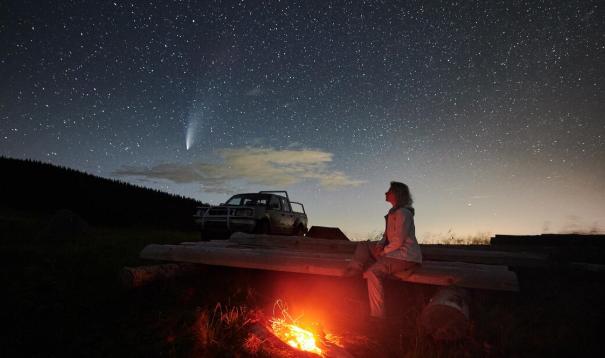
Southern Hemisphere observers will be in the best position to witness MAPS if it survives. The geometry is not very favorable above the equator, but in the days after perihelion, around April 9, northern skywatchers might get a quick, low glimpse on the horizon. To be honest, it’s a little annoying that for the majority of readers, one of the most dramatic events of the month may occur below the horizon. Even so, it’s a spectacle in and of itself to know that a piece of old rock and ice is making a potentially lethal plunge around the sun.
C/2025 R3, the second comet, is easier to reach and possibly more consistently productive. The comet made its closest approach to Earth on April 27, coming within 44 million miles, and NASA identified April 17 as the best time to see it. Although there are the usual disclaimers, some astronomers believe that this comet may be the brightest one to be seen this year. Crowds expecting fireworks have long been let down by comets. In 1973, Comet Kohoutek—famously dubbed the “comet of the century”—arrived essentially as a smudge. Nevertheless, R3’s tracking data is more promising than most, and even a small comet visible to the unaided eye from a dark hillside on a moonless night is worth seeing.
For casual observers, the planet parade, which takes place roughly from April 16 to 23, is perhaps more visually pleasing and easier to schedule. For approximately 30 minutes prior to sunrise, Mercury, Mars, and Saturn will form a tight triangle in the predawn sky just above the eastern horizon. It is worthwhile to observe the formation over several mornings rather than treating it as a single event because it changes slightly every morning, tightening into a pyramid shape, stretching into a diagonal line, and then pulling back together. When the three planets are closest together, on April 18 and 20, the views will be clearest. Large lakes or open shorelines facing east are ideal; anything that gets rid of obstacles at the horizon is very beneficial.
The Lyrid meteor shower then peaks on the evening of April 21 and continues into the morning of April 22 in the midst of all of this. The Lyrids originate from Comet Thatcher’s thousands of years’ worth of debris, which Earth plows through every year, causing the particles to burn through the atmosphere as streaks of light. Under truly dark skies, the shower usually produces 10 to 20 meteors per hour. It’s not the most frequent shower of the year, but it’s dependable and occurs early enough in spring that the nights aren’t too cold in most of the northern hemisphere. The fifth brightest star in the night sky, Vega, is located close to the radiant point in the constellation Lyra. On April 21, start looking east at around 10 p.m. and give your eyes at least 20 minutes to adjust before evaluating the show’s quality.
The way the lineup is stacked this month makes it difficult to avoid feeling a little overwhelming. From April 18 to 24, there will be a full moon, two comets with uncertain futures, a meteor shower, a close-knit planetary cluster, and Venus blazing in the western sky after sunset. April doesn’t typically inquire about a person’s sleep schedule to this extent. However, there’s a special satisfaction in rising early on a chilly April morning, locating a shadowy area of ground far from the closest streetlight, and gazing up at something that has been moving toward this precise moment for thousands of years. The alarm was worthwhile.