

Most people won’t be aware of it. As the sky grows darker, they’ll drive home, shut the blinds, and browse through whatever the evening has brought to their phones. However, there’s a chance that you will witness something that no living person has ever seen from this planet: a comet finishing an orbit that it started 170,000 years ago, before Homo sapiens had left Africa, if you happen to step outside just before dawn this month and look east. It’s not a figure of speech. It is the truth, plain and simple.
The Lyrid meteor shower, an exceptionally well-positioned Mercury, and two comets that appear in the same calendar month in April 2026—possibly both reaching naked-eye visibility—are providing skywatchers with something that expert astronomers are already describing as truly unusual. It’s a once-in-a-lifetime sky month that merits greater attention than it is currently receiving.
| Topic Overview: April 2026 Double Comet Event | |
|---|---|
| Event | Two comets visible in the same month — an exceptionally rare occurrence |
| Comet 1 | C/2026 A1 (MAPS) — Kreutz sungrazer, discovered January 13, 2026 |
| Comet 1 Perihelion | April 4, 2026 — passed within 161,000 km above the Sun’s surface |
| Comet 1 Visibility Window | April 7 onward (if it survives), low western horizon after sunset |
| Comet 2 | C/2025 R3 (PanSTARRS) — stable long-period comet, orbits every ~170,000 years |
| Comet 2 Perihelion | April 19–20, 2026 — passes ~0.5 AU from the Sun |
| Comet 2 Closest Earth Approach | April 27, 2026 — within 44 million miles of Earth |
| Best Viewing Date (NASA) | April 17, 2026 — optimal predawn conditions near new moon |
| Comet 2 Discovery | Sept. 7, 2025, by Pan-STARRS telescope at Haleakalā, Hawaii |
| Additional Sky Event | Lyrid meteor shower peaks April 21–22, from Comet Thatcher debris |
| Recommended Equipment | 10×50 binoculars; apps like Stellarium or Night Sky for precise location |
The dramatic comet is the first one, C/2026 A1 MAPS, which might not even last long enough for you to see it. It was found in January 2026 and is categorized as a Kreutz sungrazer, which means it is a member of a family of comets that travel through the inner solar system very close to the Sun. It passed within about 161,000 kilometers of the Sun’s surface at its perihelion on April 4, which is less than half the separation between Earth and the Moon. It’s hard to imagine the heat at that close. The comet either emerges from the encounter with a spectacular tail or simply disintegrates, depending on how big the nucleus is and how well it holds together. The ice inside the comet’s body starts to turn directly to gas. Both possibilities were equally matter-of-factly described by amateur astronomer Michael Mattiazzo, who was able to take a telescope photo of the comet before it approached the Sun in late March. The comet could perform. Alternatively, it may no longer exist. Every astronomer eventually says, “Comets are like cats—they do what they want.”
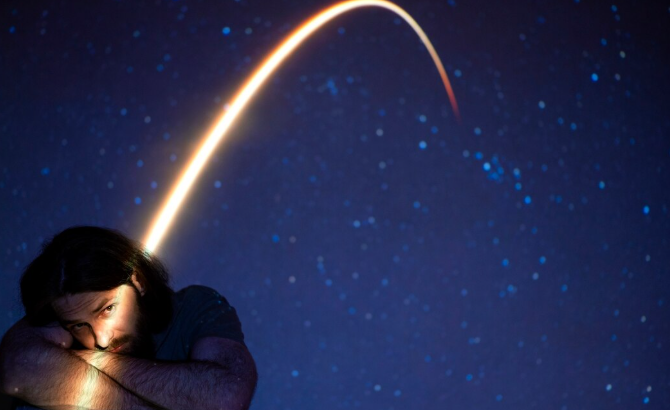
The viewing window opens on April 7, just after sunset, low on the western horizon, if C/2026 A1 MAPS makes it through its solar flyby. You are searching for the spot just above the horizon where the Sun descended. While viewers in the northern hemisphere should not give up completely, those in the southern hemisphere have a noticeably better view. According to some predictions, the comet’s tail could extend up to 40 degrees across the sky if it survives intact. This is equivalent to multiplying the distance between your fist and your open hand held at arm’s length by eight. It would be difficult to overlook. However, that’s a big if, and it’s better to sit with the real uncertainty than to have unrealistic expectations for the comet.
The second comet has a completely different personality. For a comet, C/2025 R3 PanSTARRS is nearly comfortingly well-behaved, stable, and reasonably predictable. The Pan-STARRS survey telescope at the Haleakalā observatory in Hawaii made the discovery on September 7, 2025. It completes a full orbit of the Sun approximately every 170,000 years. The people who may have witnessed it the last time it traveled through this region of the solar system were not yet fully human. When you sit with that number for a moment, there’s something truly disorienting about it. With the comet reaching perihelion on April 19–20 and its closest approach to Earth on April 27—within 44 million miles of our planet—NASA has identified April 17 as the best date to catch it. The moon’s waning toward a new moon phase on April 17 will improve viewing conditions by making the sky background darker than usual and giving fainter objects a better chance.
The Northern Hemisphere has the best viewing geometry for PanSTARRS, at least through the middle to end of April. About ninety minutes before sunrise, the comet moves close to the Great Square of Pegasus in the predawn eastern sky. According to brightness estimates, it might reach magnitude 2 to 3, making it one of the more noticeable objects in a dark sky. If conditions are right, it could be easily seen without the use of optical aids. Comet brightness predictions, however, come with an asterisk of their own. There are many comets in astronomy history that came as expected wonders and left as disappointing smudges. PanSTARRS’s exact brightness is still unknown, and comet watchers who have been burned in the past tend to be cautious about their enthusiasm.
The advice is simple and practical. In the week after April 7, look west right after sunset for C/2026 A1 MAPS. Through mid-April, with April 17 being the best date, set an alarm for approximately 90 minutes before sunrise and face east for PanSTARRS. Dark skies are very beneficial to both comets; it makes a noticeable difference to be even 15 or 20 minutes away from city lighting. The most practical item you can bring is a pair of 10×50 binoculars, which increase your field of vision and capture significantly more light than your own eyes. You can download apps like Stellarium or Night Sky in a matter of minutes, and they will display the exact location of each comet in relation to the nearby stars on any given night. However, there is no replacement for going outside. Watching a smudge of light that has been moving toward you for longer than your species has existed is an experience that no app can match.
When you include the Lyrid meteor shower, which peaks on April 21 and 22 and radiates from the direction of the star Vega, which is high in the eastern sky starting at around 10 p.m., April’s sky is creating a month that is worth losing a little sleep over. It’s difficult to ignore how noisy the outside world is at the moment. At least there’s something quieter in the sky. This week, look up before dawn. The comets won’t wait for whatever April has in store.