

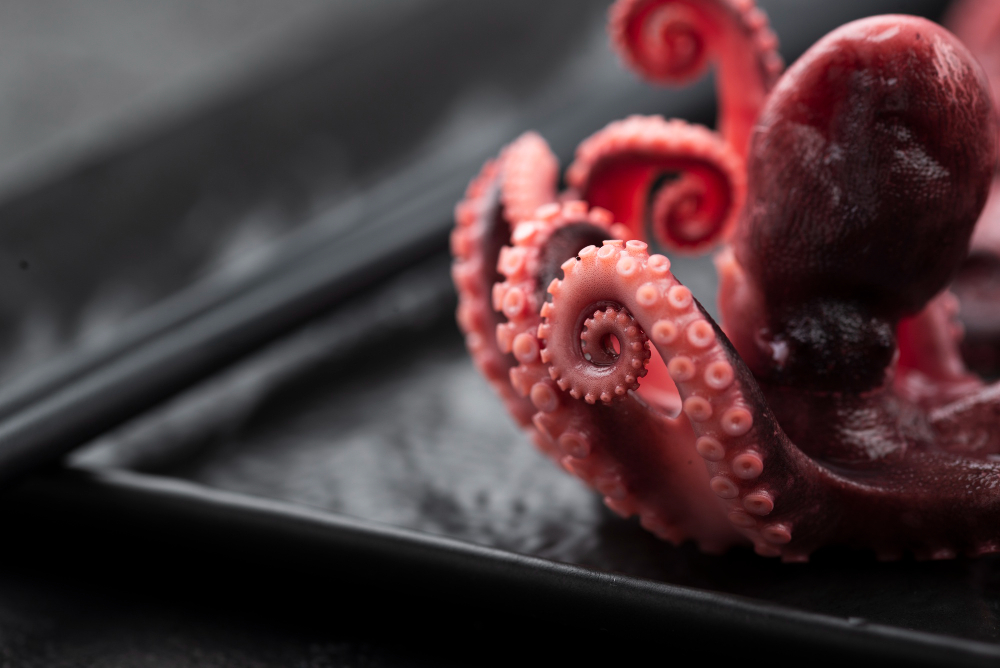
An octopus by the name of Inky made a choice one evening at the New Zealand National Aquarium in Napier. Although it wasn’t a clear invitation, his tank lid was left slightly open. After hauling himself out of the water at some point in the dark, Inky found a drain pipe, crossed about four meters of aquarium floor, and vanished into the Pacific Ocean. The following morning, staff used a wet trail and sucker marks on the floor to piece together the story. There was still Blotchy, the male octopus that Inky had been sharing his tank with. It wasn’t random behavior, regardless of what motivated Inky—urgency, curiosity, or some internal calculation we can’t quite put our finger on. It was a strategy.
That tale, which made unexpected headlines around the world in 2016, explains why octopuses frequently find themselves at the center of the most awkward discussions in neuroscience. They are not adorable mammals with clear expressions and liquid eyes. Despite being invertebrates—cold, soft-bodied, and radically alien in their architecture—something about their behavior consistently demands to be taken seriously. There is increasing scientific agreement that octopuses are most likely sentient and that their awareness, whatever it may be, did not evolve along the same path as human consciousness. It came from a completely different place. This is what makes this intriguing from a scientific standpoint and somewhat disorienting from a philosophical one.
| Last Common Ancestor with Humans | ~600 million years ago — a flatworm-like creature; consciousness evolved entirely independently |
| Nervous System Structure | ~500 million neurons total; ~2/3 distributed across 8 semi-autonomous arms, each with its own mini-brain |
| Cambridge Declaration (2012) | Signed by leading neuroscientists; octopus named as the only invertebrate with neurological substrates for consciousness |
| Pain Sentience (LSE Report) | 300+ scientific papers reviewed; octopuses meet criteria for sentience including nociceptors, associative learning, and flexible self-protective behavior |
| Tool Use Evidence | 2009 study documented octopuses collecting coconut shells as portable shelters — one of the clearest examples of invertebrate tool use |
| Sensory Uniqueness | Suckers contain chemoreceptors that “taste” everything touched; arms more like tongues/lips than hands |
| Key Researcher | Peter Godfrey-Smith, Prof. of History & Philosophy of Science, University of Sydney; author of “Other Minds” |
| Notable Escape Case | Inky the octopus escaped the New Zealand National Aquarium in Napier, traversed the floor, and exited through a drain to the Pacific Ocean |
| Ethical Implication | Nueva Pescanova seeking license for world’s first commercial octopus farm — generating significant animal welfare debate |
| Reference / Research Hub | neuroscience.stanford.edu — Wu Tsai Neurosciences Institute |
For the majority of the 20th century, brain structures served as the foundation for the conventional theory of animal consciousness. The cerebral cortex, the wrinkled, evolutionarily recent outer layer of the mammalian brain responsible for higher cognition, was found to be the site of complex awareness. It was assumed that if a creature lacked one, it most likely had little inner life. There is no cortex in octopuses. They lack a spine. About 600 million years ago, they shared a common ancestor with humans that resembled a flatworm. Nevertheless, the octopus was the only invertebrate specifically identified as having the neurological underpinnings of consciousness when a group of cognitive neuroscientists, neurophysiologists, and neuroanatomists convened at Cambridge University signed the Cambridge Declaration on Consciousness in 2012. Not because they resemble us. Because the old model begins to fall apart when you examine their nervous system in sufficient detail.
About 500 million neurons make up an octopus, which is comparable to a small mammal. The interesting thing is the location of those neurons. Instead of being found in the central brain, about two-thirds of them are dispersed throughout the eight arms. Every arm has a unique neural cluster that can process information and move on its own. An octopus will react to stimuli for an hour if its arm is severed and placed in a tank. The arm is unaware that it has been severed. That begs the question, “Where exactly is the octopus?” to which neuroscience is unable to provide definitive answers. Is consciousness distributed, operating in parallel across several semi-autonomous systems, or is it centralized, as it appears to be in humans? The possibility of a “partial fragmentation”—possibly a looseness in the integration that human consciousness takes for granted, rather than multiple selves—is described by Peter Godfrey-Smith, a philosopher of science at the University of Sydney and arguably the most thoughtful author working on this topic.
It’s also really hard to imagine what it’s like to be an octopus from the inside. Chemoreceptors are found in the suckers lining each arm; as the animal moves through its environment, it continuously tastes everything it touches. Godfrey-Smith has likened the arms more to tongues or lips than to hands because these surfaces are tasting rather than merely manipulating their surroundings. There is nothing in the human sensory repertoire that can compare to the sheer amount of sensory information coming from eight constantly moving, tasting limbs. The question that prevents this field from finding a satisfactory solution is what that information feels like to process—whether it feels like anything at all.
After years of reviewing more than 300 scientific papers on cephalopod sentience, researchers at the London School of Economics came to the conclusion that octopuses are capable of feeling pain because they have nociceptors, integrative brain regions, flexible behavioral changes in response to injury, and associative learning that goes beyond simple reflex. In a rare instance of philosophy leading to legislation, the United Kingdom included cephalopods in its animal welfare laws as a result of that 2021 report. As this field develops, there’s a sense that the ethical implications of what we’re learning are emerging more quickly than science can fully process them.
which makes the situation uncomfortable. Nueva Pescanova, a global seafood company, is presently requesting licenses to establish the first commercial octopus farm in history in the Canary Islands. Thousands of animals would be involved in the project. Because there is now a tangible response to the question of octopus sentience, the debate surrounding it has been exceptionally intense. The permits’ approval and the regulators’ willingness to pause due to the new science are still up in the air. Right now, it seems more difficult to argue that the science itself is ambiguous. The octopus’s evolutionary route to consciousness was entirely different from our own. That is not a neuroscience footnote. The conclusion is that.