

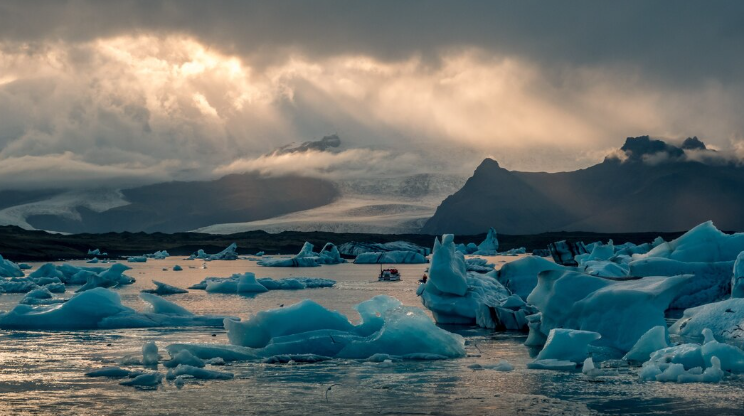
The Arctic doesn’t make a big deal out of its changes. There aren’t any abrupt explosions or dramatic turning points that can be identified in an instant. Rather, it changes subtly, with meltwater collecting in areas that were once permanently frozen and ice thinning at the edges. However, the data presents a different picture. The region is warming up to four times faster than the global average, and it’s hard not to feel that something fundamental is slipping.
You can see the changes from year to year when you stand on satellite imagery, those stark, almost abstract white-and-blue maps. The ice appears more fractured and less solid. It’s possible that we’re seeing acceleration rather than just warming. This distinction is more important than it may seem.
| Category | Details |
|---|---|
| Region | Arctic (Northern Polar Region) |
| Phenomenon | Arctic Amplification |
| Warming Rate | Up to 4× faster than global average |
| Temperature Rise | ~3°C since industrial era |
| Primary Driver | Ice-albedo feedback |
| Key Factors | Reduced convection, water vapor, permafrost thaw |
| Environmental Impact | Sea ice loss, ecosystem disruption, weather shifts |
| Scientific Field | Climate Science |
| Notable Concept | Positive feedback loops |
| Reference | https://www.arcticwwf.org |
Color is the deceptively straightforward element at the heart of it all. Sunlight is reflected back into space by the bright, reflective ice and snow. However, darker ocean water replaces that ice as temperatures rise and it melts, absorbing heat rather than rejecting it. The term “ice-albedo feedback” is used by scientists to describe what is essentially a runaway loop, but it seems almost too tidy. More heat causes more ice to melt. Heat is absorbed more when there is less ice. The cycle becomes more rigid.
In real life, there is a moment that is frequently missed when this manifests. Dark water is visible beneath a patch of sea ice that has broken. It doesn’t appear dramatic. However, it’s an obvious change in energy balance and physics.
However, melting ice isn’t the only factor contributing to the warming of the Arctic. Convenient as it is, that explanation seems lacking. Here, the atmosphere itself acts in a different way. Heat rises and moves through layers of air in warmer climates. That mixing hardly occurs in the Arctic. Heat is trapped where it matters most because cold air remains near the surface. Warming that persists rather than dispersing is an odd inversion.
It seems that outside of scientific circles, this “trapped heat” effect receives insufficient attention. It is less obvious and intuitive than melting ice. However, it subtly amplifies everything else.
And there’s moisture. More moisture is transported north from the tropics as global temperatures rise because warmer air can hold more water vapor. Heat is released into the atmosphere when it cools and condenses in the Arctic. It’s a gradual, nearly imperceptible process that never stops. It warms an area that is already having trouble cooling itself layer by layer.
There’s a sense that the atmosphere is getting heavier and more insulated as weather systems change over the Arctic, with storms forming differently and clouds staying longer. Whether this trend will level off or keep getting stronger is still unknown.
Beneath it all, the ground is literally changing. Soil that has been frozen for thousands of years, known as permafrost, is starting to thaw. Methane and carbon dioxide, two gases that trap additional heat, are released when it does. Because it operates out of sight, this type of feedback loop is unsettling. Permafrost does not thaw in the same way that ice does. However, its consequences might be equally important.
This has a subtle irony. In the past, the Arctic was thought to be a stable, nearly frozen repository of Earth’s history. It is currently changing more quickly than many models predicted, making it one of the planet’s most dynamic regions. According to some studies, the speed at which this amplification is occurring may be underestimated by the current climate models.
That doubt persists. Whether the Arctic will keep warming at this rate or if certain processes will start to reverse the trend is still unknown. But caution is advised by history. Once established, feedback loops are typically hard to break.
Beyond science, there is a more difficult-to-quantify human component. Communities in the Arctic are already making adjustments to their hunting habits, reconstructing infrastructure on shaky terrain, and observing the erosion of their coastlines. Although they don’t always make headlines, these changes provide a subdued background for the data.
In cities far from the poles, it’s difficult to ignore how disconnected all of this seems from daily life. The Arctic does not, however, exist in a vacuum. Weather patterns throughout the Northern Hemisphere are impacted by changes made here. Although the relationships are still up for debate, there is mounting evidence connecting warming in the Arctic to more unpredictable winters in North America and Europe.
That discussion is important. It implies that the Arctic still has a degree of unpredictability despite decades of research. Although the mechanisms are generally understood by scientists, the interactions between ice, air, water, and soil are intricate and occasionally contradictory.
There’s a sense that the Arctic is more of a preview than a warning as this develops. a location where the effects of global warming manifest more quickly, more intensely, and earlier. It’s sensitive, not because it’s special.
And perhaps the most crucial detail of all is that sensitivity. It implies that minor adjustments made elsewhere may have more significant effects here. It indicates that the Arctic reacts fast—sometimes too fast for comfort.
The ice is still getting thinner. The atmosphere is still changing. The final result is still unclear, hovering between what we know and what we’re still trying to understand, even though the causes are becoming more apparent.