

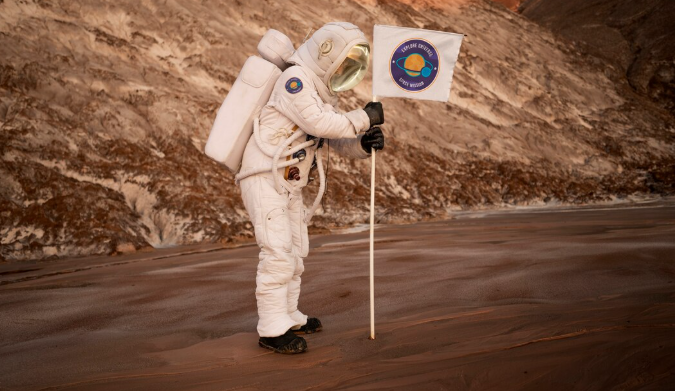
The thought of chickpeas growing beneath a sky that never turns blue seems subtly surreal. There was only fine gray dust blowing in all directions—no wind, no insects. However, scientists have already started to replicate that exact situation in a lab far from the Moon, experimenting with dead regolith, extracting something green from it, and observing it struggle and eventually survive.
The most recent experiments seem more like practice than conjecture. By combining worm-produced compost and protective fungi with soil that mimics lunar dirt, researchers have successfully grown and harvested chickpeas. Although it isn’t particularly lush farmland, the outcome is vibrant. It feels like a change just from that.
| Category | Details |
|---|---|
| Topic | Lunar Agriculture Breakthrough |
| Key Crop | Chickpeas |
| Research Institutions | University of Texas at Austin, Texas A&M University |
| Space Agencies Involved | NASA, European Space Agency (ESA) |
| Core Challenge | Turning lunar regolith into fertile growing medium |
| Key Techniques | Vermicompost, fungi inoculation, hydroponics |
| First Proof | Plants grown in real lunar soil (NASA, 2022) |
| Latest Milestone | Chickpeas grown in simulated moon soil (2026) |
| Main Concern | Toxic metals and nutrient balance |
| Reference | https://www.sciencedaily.com/ |
It’s simple to forget the Moon’s true hostility. Regolith, the surface material, is metallic, sharp, and devoid of any organic life. No microorganisms. No decomposing vegetation. Just crushed rock under intense radiation. There is no place for plants. However, under controlled circumstances, they have begun to establish themselves, growing slowly and unevenly but clearly.
This breakthrough doesn’t seem to have happened all at once. Over years, it gradually infiltrated. In 2022, researchers were able to cultivate a tiny plant known as Arabidopsis using real lunar samples. It was alive, but it wasn’t flourishing—its growth was stunted and its leaves appeared stressed. A straightforward, almost unyielding question was brought up by that moment: if something can grow, even badly, what will happen if we assist it?
The solution appears to be clever borrowing from Earth, at least for the time being. Vermicompost, a nutrient-rich substance created by worms breaking down organic waste, was added to the chickpea experiment. When compared to the scope of space exploration, it’s a peculiarly modest and grounded solution. However, it was successful. In mixtures with up to 75% simulated moon soil, the plants flourished.
One can practically picture the trays under gentle artificial lighting and the subtle scent of damp soil that isn’t actually soil when reading descriptions of these lab setups. Leaning in, scientists observe roots growing where they shouldn’t. It’s difficult to ignore how much of this work seems spontaneous and even a little brittle.
The fungi come next. These microscopic partners coat the seeds prior to planting, protecting them from harmful metals and assisting the plants in absorbing nutrients. The crops suffer without them. They last longer with them. Future lunar farms might rely more on these silent biological partnerships and less on machinery.
However, the optimism is accompanied by reluctance. Plant cultivation is one thing. It’s another to eat it. The amount of heavy metals from the Moon that find their way into the crops is still unknown. The safety and nutritional value of these chickpeas for astronauts who depend on them are still unknown.
In the meantime, scientists and engineers are investigating a related concept: completely avoiding soil. The European Space Agency has been researching hydroponics, which uses nutrient-rich water rather than soil to grow plants. If processed properly, lunar dust could provide some of those nutrients. The idea seems more controlled and tidy. However, it also calls into question reliability and complexity at great distances from Earth.
All of this has a practical tension as well. It costs money, effort, and risk to send one kilogram to the moon. The goal of farming there is independence as much as sustainability. Longer stays, possibly even permanent presence, are the goal of NASA’s Artemis missions. And food eventually turns into the silent restraint.
It’s difficult to avoid drawing comparisons to Earth’s early agricultural experiments—those tentative attempts to domesticate plants, not knowing if they would survive the next season or produce enough. The stakes are higher here, though. On the Moon, there are no natural backups. There is no rain. No recovery of the soil.
It seems like the science is only now starting to catch up with the ambition as this develops. Policymakers and investors appear interested, even optimistic, but wary. Lunar farming sounds audacious, almost cinematic. However, the reality is more gradual—one experiment, one crop, one precarious success at a time.
Even so, something has changed. It may not seem dramatic at first to grow chickpeas in simulated moon dirt. However, from a distance, it seems like a tiny fissure in a much bigger wall. The Moon begins to resemble a place where people might stay rather than a destination if food can grow there, even if it is imperfect.
What happens next will determine whether or not that vision is realized. More experiments. Probably more failures. And eventually, maybe, a greenhouse on the moon’s surface, silently yielding the first true harvest outside of Earth while dimly glowing against the darkness.