

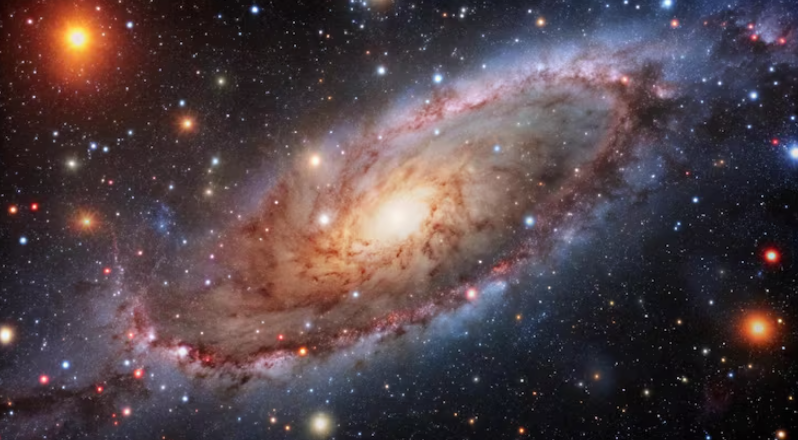
The most recent image from NASA’s James Webb Space Telescope has a subtly unsettling quality. It’s not because it’s dark—space has always been dark—but rather because of what lurks within. At first glance, what appears to be a smear of purples and faint reds is actually one of our galaxy’s busiest regions, where stars are being born more quickly than astronomers had previously thought.
The image centers on Sagittarius B2, a dense molecular cloud that is cosmologically close to the central black hole of the Milky Way. Although researchers have been studying this area for many years, Webb appears to have removed a layer that was beyond the reach of earlier telescopes. It reveals clusters of young stars that were previously invisible by using infrared instruments to cut through dust that would otherwise obscure the view.
| Category | Details |
|---|---|
| Telescope Name | James Webb Space Telescope (JWST) |
| Agencies | NASA / ESA / CSA |
| Launch Date | December 25, 2021 |
| Location | Sun–Earth L2 (1.5 million km from Earth) |
| Mission Type | Astrophysics |
| Key Instruments | NIRCam (Near-Infrared Camera), MIRI (Mid-Infrared Instrument) |
| Target Region | Sagittarius B2 (near Milky Way center) |
| Scientific Focus | Star formation, cosmic dust, early galaxy evolution |
| Notable Feature | Infrared imaging revealing hidden stars |
| Reference | https://science.nasa.gov/mission/webb |
It’s difficult to ignore how disorganized the scene appears. Something messier, almost bruised, rather than the tidy, spiral elegance that people associate with galaxies. The colors are erratic, glowing patches strewn over a dense gas backdrop. That goes beyond aesthetics. It implies that the cloud is being actively shaped by turbulence or compression. Even a sharp edge runs along one side, suggesting that the gas may have been compressed during a previous event.
The intense star formation in Sagittarius B2 may be caused by this compression, according to astronomers. However, the cause is still unknown. Maybe a shockwave. or interactions with structures in the vicinity of the galactic center. There’s a feeling that the origin story is still unfinished despite Webb’s clarity.
The most striking thing is how many stars were just absent from previous counts. Different wavelengths are picked up by Webb’s instruments, MIRI and NIRCam, which show the warm dust surrounding the glittering stars. Even Webb finds it difficult to see through the dust in some places. Those dark patches aren’t empty. They may form the next generation of stars because they are packed with material.
Scientists’ perceptions of our galaxy have subtly changed as a result of this realization. It’s possible that other regions of the Milky Way are similarly underappreciated if one area can conceal this much activity. The galaxy may be more active and productive than models have indicated.
This is also part of a larger context. The James Webb Telescope was built to see far into the early universe and record light from the earliest galaxies. However, some of its most unexpected discoveries are occurring much more locally. It’s nearly ironic. The device is making us reevaluate our own galactic neighborhood after decades of looking outward.
As this develops, it seems as though astronomy is about to enter a somewhat unsettling stage. The data is too revealing, not because it is ambiguous. Long-held beliefs about the formation process, rate, and location of stars are beginning to appear unstable.
Sagittarius B2 might be an anomaly. a very extreme area close to the galactic center that is shaped by unique forces. However, it’s equally possible that it’s nothing out of the ordinary. that when the obscuring dust is removed, what Webb is depicting here is a more realistic representation of how galaxies truly appear.
That argument is not resolved by the image alone. It makes things more difficult.
And that might be the most fascinating aspect. It was anticipated that the James Webb Space Telescope would provide answers. Rather, it raises new questions about hidden stars, invisible structures, and the possibility that even our own galaxy is still, in some respects, uncharted territory in areas like the core of the Milky Way.