

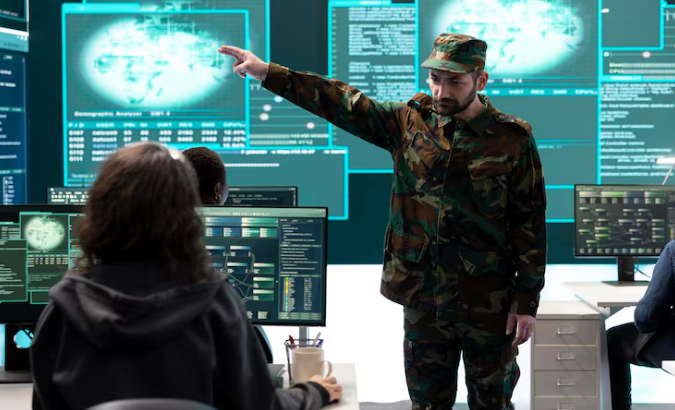
The screens in a quiet intelligence facility somewhere in Israel never truly darken. While software processes streams of surveillance data arriving from drones, satellites, and intercepted communications, analysts rotate shifts and coffee cups gather next to keyboards. The space resembles the operations floor of a tech startup rather than a battlefield command center. However, the choices made here have the power to decide whether a structure in Gaza is still standing tomorrow morning.
The odd reality of contemporary warfare is encapsulated in that contrast—code operating silently while missiles roar elsewhere.
| Category | Information |
|---|---|
| Military Organization | Israel Defense Forces |
| Known AI Systems | “Habsora” (The Gospel), “Lavender”, “Where’s Daddy” |
| Function | Data analysis and target recommendation for military strikes |
| Conflict Context | Israel–Hamas conflict and broader regional security tensions |
| Estimated Targets Identified | Up to 100 targets per day through AI-assisted systems |
| Data Sources | Drone surveillance, communications intercepts, intelligence databases |
| Key Debate | Civilian safety, human oversight, accountability in automated warfare |
| Legal Framework | International Humanitarian Law |
| Military Technology Category | AI-assisted decision-support systems |
| Reference Source | https://www.theguardian.com |
The Israel Defense Forces, the military branch in charge of these operations, have been incorporating artificial intelligence into its intelligence networks for years. Large databases of data are analyzed by systems with names that sound almost abstract, like Where’s Daddy, Lavender, and Habsora. In theory, their goal is simple: to find potential targets more quickly than human analysts could.
Defense analysts frequently discuss one statistic. Israeli intelligence may have identified about fifty targets annually during previous conflicts. According to reports, the same process can produce about 100 possible targets in a single day with AI-assisted systems operating continuously.
In reality, these systems function more like extremely effective research assistants than autonomous weapons. Algorithms flag people or places that may be connected to militant groups by sorting through patterns in phone activity, movement data, and surveillance photos. According to military statements, the final decision is still approved by human officers. However, as datasets grow, the speed at which information is produced can make human review feel more and more constrained.
The defense establishment’s supporters contend that AI lessens guesswork. Under pressure on the battlefield, human analysts might find it difficult to cross-reference intelligence reports, drone imagery, and communication logs in a matter of seconds. Advocates claim that this results in fewer errors and more precise targeting.
However, outside of military circles, the confidence surrounding these claims frequently seems to be weaker.
Journalists’ and human rights researchers’ investigations have revealed that some of these systems produce lengthy lists of suspected militants based on probabilistic models rather than concrete proof. According to reports, the Lavender system identified tens of thousands of people who may have connections to militant groups by analyzing millions of data points from Gaza residents.
Because data patterns can be deceptive in densely populated areas. Algorithmic suspicion may be triggered by calling the incorrect number, using a shared internet connection, or being close to another suspect. As this discussion develops, it seems possible that the messy unpredictability of human life will clash with the technology’s promise of accuracy. The evaluation of targets is another contentious issue.
According to some reports, algorithms may be able to determine how many civilians might be in the vicinity of a target. Based on anticipated collateral damage, the system then assigns a risk score, such as green, yellow, or red. Military planners insist these calculations help reduce civilian casualties by improving decision-making. Skeptics are still not persuaded, though.
The language of algorithmic precision feels uncomfortable in light of the physical reality of the Gaza Strip following months of bombardment—flattened neighborhoods, damaged hospitals, displaced families. Even experts who think AI can help with intelligence analysis admit that there isn’t much evidence in the public domain that these systems consistently lessen harm to civilians.
The controversy revolves around this discrepancy between battlefield results and technical promise.
Military technology has always advanced more quickly than the laws intended to control it. Cyberwarfare, satellite surveillance, and drones all emerged before governments could figure out how to handle the fallout. It seems that artificial intelligence is going in the same direction, albeit more quickly.
The legal issues are intricate. Attacks must be proportionate and distinguish between combatants and civilians in accordance with international humanitarian law. However, it becomes more difficult to assign blame when algorithms are used to identify targets. Who is at fault if a machine’s recommendation results in an incorrect strike—the commander who authorized it, the intelligence officer, or the programmer?
Whether current legal frameworks are ready for that question is still up for debate.
Other armed forces are keeping a close eye on Israel. Similar decision-support systems are being tested in the US, China, and a number of European countries. Many strategists think AI will eventually be just as important to warfare as GPS and radar were. And there is tension associated with that possibility.
Because other states will adopt these systems faster if they seem to be more effective. A covert algorithmic arms race is already in progress, taking place behind closed doors in defense ministries and research labs.
One aspect of the debate that is difficult to overlook is that, although intelligence has always been crucial to warfare, the scope of intelligence processing has drastically changed. Algorithms now scan vast amounts of data in real time, whereas analysts used to manually sort through reports.
Observing this change gives rise to an odd sense that warfare is about to enter a new stage, one in which the most important choices may be made by lines of code operating silently on distant servers rather than by generals or pilots.