

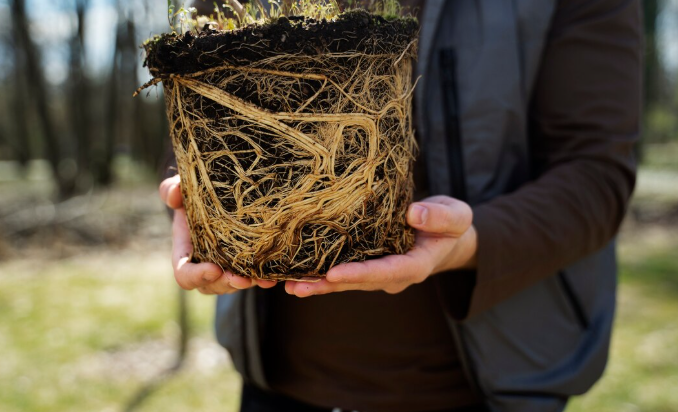
At first glance, the forest frequently seems peaceful. The wind is blowing through the branches. Softly moving leaves above. In the background, a few insects are buzzing. It feels serene, almost motionless, standing among towering firs or ancient beeches. However, scientists now believe that beneath the serene exterior lies something much busier—an underground network that subtly unites trees into something more akin to a community than a group of individuals.
Mycelium, a delicate web of fungal threads, is found just a few centimeters below the forest floor. These threads come from fungi that form what biologists refer to as mycorrhizal networks by attaching themselves to tree roots. The partnership is useful. Fungi receive the sugars that trees produce through photosynthesis. In exchange, the fungi extract water and minerals from the soil that are difficult for roots to access on their own. Basically, a trade agreement. However, the arrangement seems to involve more than just trading.
| Topic | Key Information |
|---|---|
| Subject | Mycorrhizal Networks (“Wood Wide Web”) |
| Scientific Field | Forest Ecology, Plant Biology, Soil Microbiology |
| Key Discovery | Trees connected by underground fungal networks |
| Main Organisms | Tree roots and mycorrhizal fungi |
| Core Function | Exchange of nutrients, carbon, water, and signals |
| Key Researcher | Suzanne Simard (University of British Columbia) |
| Key Concept | “Mother Trees” supporting younger trees |
| Communication Method | Chemical signals and nutrient transfer through fungal hyphae |
| Ecological Impact | Improves forest resilience and seedling survival |
| Reference | https://en.wikipedia.org/wiki/Mycorrhizal_network |
Researchers looking at forests in the Pacific Northwest, Canada, and Germany started to notice something strange. At times, trees connected by these fungal networks appeared to share resources. Younger seedlings receive carbon from older trees. Nitrogen is transferred between species. In some experiments, after a tree was attacked by insects, scientists even found chemical signals propagating through the underground web.
The ground gives a little underfoot when you walk through a dense forest after it has rained. Decaying leaves, damp soil, faint strands of white fungi threading through the darkness below. It’s difficult not to see the location as alive in previously undetectable ways. Many ecologists now think that the real action is taking place in that dark layer beneath boots and roots rather than above ground in the canopy.
Suzanne Simard, a forest ecologist, is among the researchers most closely linked to this concept. Her early research in Canadian forests in the 1990s showed that trees of different species, such as paper birch and Douglas fir, could exchange carbon through shared fungal networks. It was an unexpected finding. For many years, forests were primarily thought of as battlefields where trees fought fiercely for nutrients and sunlight.
However, the data suggested a more cooperative approach. Larger, older trees, sometimes referred to as “mother trees,” seemed to be able to provide carbon to shaded seedlings that were fighting for their lives. In some instances, the flow even appeared to shift in the direction of genetically related saplings. As these patterns develop, it seems that forests act more like loosely connected societies than like solitary organisms.
Scientists are still wary, though. Researchers are cautious because some of the claims regarding tree communication sound almost poetic. It’s still unclear if fungi simply redistribute resources through the soil in ways that nearby trees happen to benefit from, or if nutrients flow directly from one tree to another through fungal pipelines. Rarely does nature make its workings clear.
The warning signals come next. Some trees release chemical compounds—defensive molecules intended to deter pests—when insects start chewing through leaves or bark. In multiple studies, similar defense chemicals were produced by nearby trees linked by mycorrhizal networks before the insects even reached them. It implies the possibility of an underground early warning system.
Imagine a forest where caterpillars are attacking. Chemical distress signals are released by the first tree to suffer. Trees in the vicinity start to change their internal chemistry, either strengthening their leaves or creating compounds that make them less appetizing. Compared to animal communication, it is a slow process that takes hours or days to complete. The coordination still seems oddly purposeful.
The fungi are not passive messengers in and of themselves. These organisms rely on trees for their sugars, sometimes obtaining up to 30% of the carbon that trees produce through photosynthesis. They provide water, phosphorus, and nitrogen from the soil in return. However, fungi also form extensive underground maps that span entire forest stands by connecting to numerous plants at once.
This system is referred to by some researchers as the “Wood Wide Web,” a playful term that conveys the scope of what is taking place. The roots of dozens or hundreds of trees are connected by miles of fungal filaments that weave through the soil. It seems as though the visible trunks of a mature forest are just the surface of a much larger structure.
The story is still unresolved, though. The amount of information that actually passes through these networks is a topic of debate among scientists. Forest ecosystems are untidy places where a multitude of organisms interact simultaneously. It is very challenging to prove that one tree purposefully uses fungi to communicate with another. Certain effects that scientists see might be the result of more basic soil processes.
Nevertheless, the findings have quietly altered public perceptions of forests. It now seems unfinished to think of trees as lone rivals, each vying for sunlight on its own. There is mounting evidence that the growth and survival of forests are influenced by collaboration, resource sharing, and covert alliances.
It’s difficult not to notice a subtle change in viewpoint as this research progresses. The forest, which was formerly thought of as a silent collection of plants, now resembles a living network that is patient, slow, and subtly interconnected beneath the ground. It’s unclear if trees actually “communicate” in the same way that people do.
However, it’s obvious that something is going on underground. And what was once thought of as plain dirt beneath a forest now seems more like a secret world.