

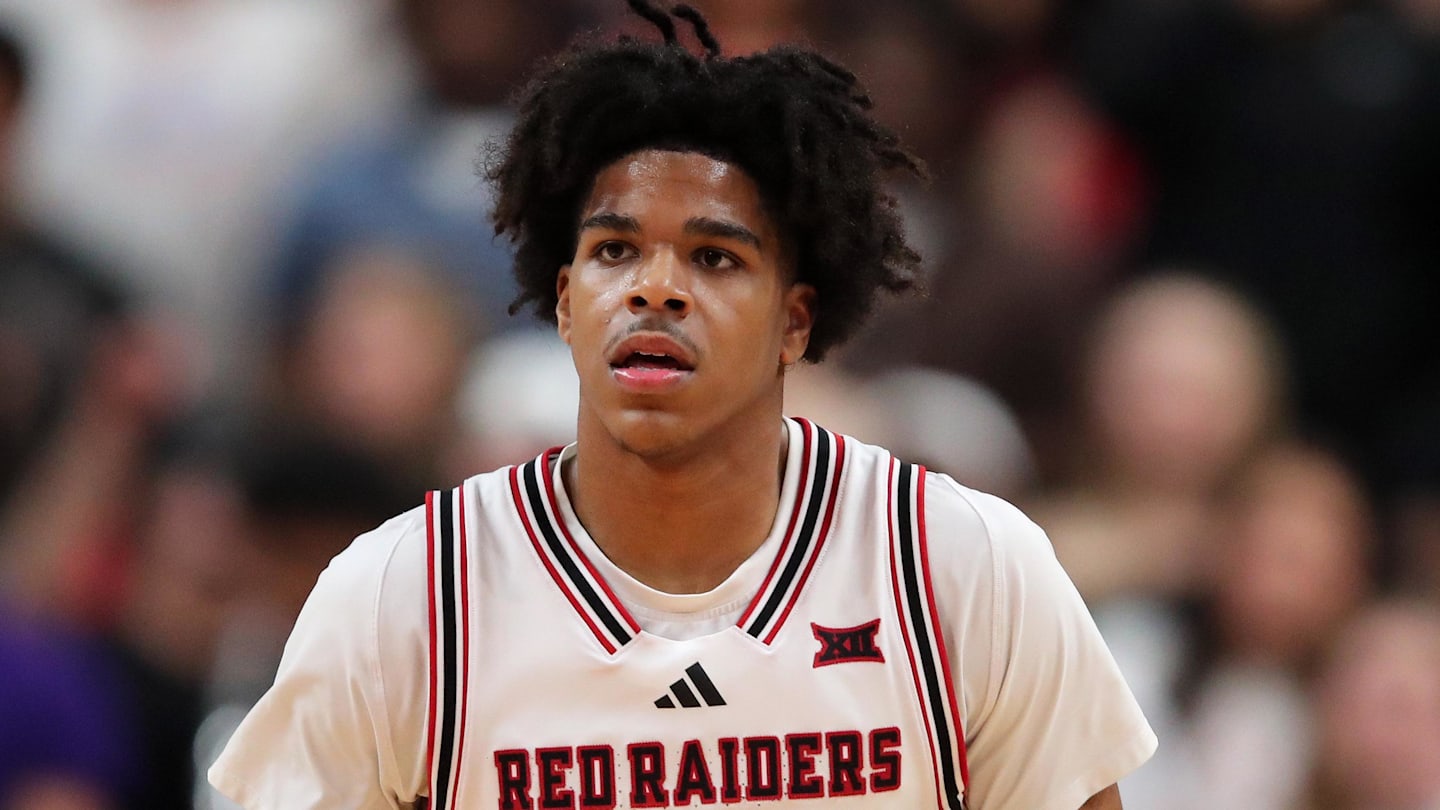
Texas Tech guard Christian Anderson has emerged as one of the most exciting NBA Draft prospects in the 2026 class, transforming into a prolific offensive force during his sophomore season. The 6-foot-2 German guard is averaging 19 points per game on 49% shooting, along with 7.7 assists and 1.3 steals, according to Texas Tech statistics. Anderson’s explosive production has placed him firmly on NBA radars as a potential first-round selection.
Anderson’s performance represents a significant leap from his solid freshman campaign. He ranks third nationally in assists per game, trailing only Jeremy Fears Jr. and Braden Smith. His 43% shooting from three-point range on nearly eight attempts per game demonstrates elite efficiency, while his 36% assist percentage underscores his playmaking abilities.
Christian Anderson Draft Stock Rising on Elite Shooting
The Texas Tech guard’s most compelling skill is his versatile three-point shooting, which scouts consider among the best in the class. Anderson has attempted 232 three-pointers through 29 games, converting at an elite 42% rate on both catch-and-shoot and off-the-dribble attempts. His mechanically sound shooting form features quick release and exceptional touch that translates across all situations.
Additionally, Anderson demonstrates limitless range and confidence from deep. He excels at creating separation through unique footwork, using long strides rather than multiple dribbles to generate shooting space. His shot preparation remains excellent regardless of position, with exceptional balance and coordination that allows him to shoot effectively both on and off the ball.
However, Anderson’s shot diet reveals heavy reliance on pick-and-roll situations. While he shoots 47% from three as the pick-and-roll handler, only 20% of his off-the-dribble attempts come without ball screens. His transition three-point shooting sits at just 26%, an area requiring improvement.
Playmaking Ability Separates Anderson From Draft Class Guards
Anderson’s facilitation skills rank among the draft class elite. His 7.7 assists per game represent the third-highest mark in college basketball, paired with a 2.25 assist-to-turnover ratio. The sophomore demonstrates advanced processing ability, leveraging his scoring gravity to create opportunities for teammates with precision passing and keen floor awareness.
Meanwhile, his off-the-dribble shot-making provides additional offensive versatility. Anderson has taken 383 field goal attempts this season, with half coming off the dribble at 43% efficiency. His effective field goal percentage of 58% on dribble jumpers grades as excellent, according to Synergy Sports analytics.
In contrast to his offensive prowess, Anderson faces questions about his physical profile. Listed at 178 pounds, he represents one of the smallest projected first-round guards in a league increasingly favoring size. His lack of elite burst and explosion raises concerns about creating separation without ball screens at the NBA level.
Defensive Potential Exceeds Expectations
Despite his size limitations, Anderson’s defensive performance surprises evaluators. He measured with a 6-foot-4.5-inch wingspan at Basketball Without Borders in 2024, allowing him to play bigger than his frame suggests. His compete level stands out, featuring consistent effort fighting through screens and contesting shots.
Additionally, Anderson’s defensive box plus-minus of 2.3 supports his on-court impact. He demonstrates anticipation and footwork that enables him to stay step-for-step with various ball-handlers. His screen navigation proves surprisingly effective, often slipping through contact while maintaining defensive position.
Nevertheless, physical limitations remain evident. Anderson’s height and strength deficiencies make him vulnerable to being outmatched by stronger, more explosive NBA guards. He can be displaced on drives and may struggle affecting shots despite his length, particularly against elite speed guards who can bypass his defensive efforts.
Finishing Craft Shows Development Potential
Anderson converts 68% of attempts around the rim despite limited explosive athleticism, according to Synergy Sports. His finishing relies on patience, craft, and exceptional footwork rather than vertical pop. He uses either hand effectively, displaying finesse with floaters and high-glass finishes with good body control.
However, rim attempts account for only 20% of his field goals, raising questions about volume. He shoots 56% on pick-and-roll twos but just 41% as a spot-up driver. His reliance on ball screens to create driving lanes mirrors concerns about his perimeter shot creation.
Anderson’s international experience with Germany’s youth national teams in FIBA U16, U18, and U19 competitions provides additional seasoning. He contributed to team success while developing against high-level competition, building experience that should aid his NBA transition. His elite conditioning allows him to play nearly 39 minutes per game for the Red Raiders.
Anderson’s draft stock currently projects from the mid-to-late first round, with potential fits including teams like the Cleveland Cavaliers, Denver Nuggets, and Minnesota Timberwolves that have successfully deployed secondary creators of similar profiles. His ultimate NBA ceiling depends on adding functional strength and demonstrating the ability to defend at an acceptable level against larger, more athletic competition.