

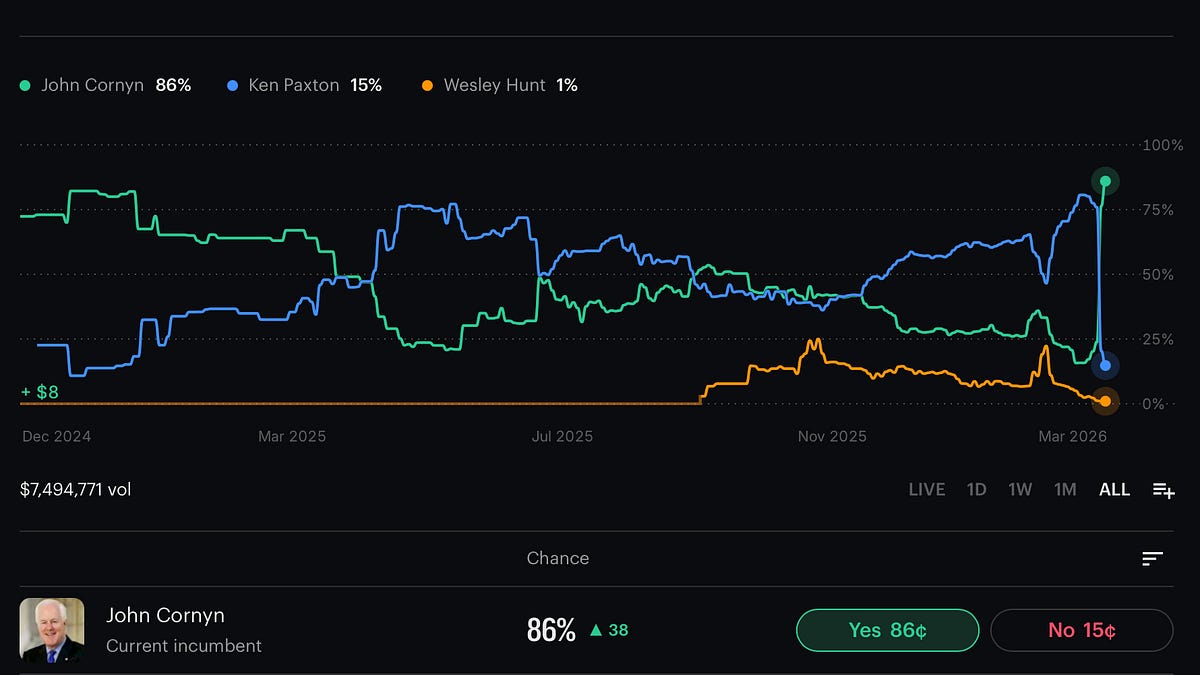
Prediction markets faced a difficult test during Tuesday’s primary elections, with several high-profile races exposing gaps between their forecasted probabilities and actual results. Platforms like Kalshi and Polymarket, which have positioned themselves as reliable election forecasting tools since their success during the 2024 presidential race, saw their predictions miss the mark on multiple contests, raising questions about their accuracy in lower-profile races.
The setbacks came as both platforms had heavily promoted their ability to predict election outcomes before polls close. According to industry reports, prediction markets have increasingly marketed themselves not just as probability indicators but as definitive forecasting mechanisms that can “call races” before they happen.
Prediction Markets Struggle With Senate and House Primaries
The Republican primary for Senate in Texas between incumbent John Cornyn and attorney general Ken Paxton illustrated the volatility. Before polls closed on Tuesday, Paxton held approximately 80% odds on both platforms, according to market data. However, Cornyn outperformed his polling numbers significantly.
The race dynamics shifted dramatically on Wednesday when reports emerged that President Donald Trump would endorse Cornyn. The market odds swung heavily in Cornyn’s favor following the news, transforming him from near coin-flip odds to a heavy favorite within hours.
Texas House Races Show Mixed Results
Additionally, several Texas House races with over $100,000 in trading volume saw unexpected outcomes. In the TX-02 Republican primary, prediction markets had heavily favored Dan Crenshaw, but he lost to Steve Toth by double digits. Meanwhile, in the TX-33 Democratic race, incumbent Julie Johnson was a decent favorite on Election Day but lost to Colin Allred by a substantial margin.
The only race where prediction markets performed well was the Democratic primary for Senate in Texas. James Talarico, whom platforms had installed as the favorite last year, won as expected. However, one prominent poll for that race also came close to the final vote totals, suggesting traditional polling methods remained competitive.
Missed Calls Raise Questions About Crystal Ball Claims
In North Carolina’s NC-04 Democratic race, prediction markets gave Nida Allam strong odds while Valerie Foushee fell as low as 4% chance to win on Wednesday night. Despite these unfavorable predictions, Foushee won the race by 1%, according to election results.
Industry observers note that prediction markets are designed to provide probability assessments rather than certainties. However, the platforms have marketed themselves as superior to traditional polls and capable of delivering advance knowledge of election outcomes, a standard they struggled to meet on Tuesday.
The Texas Senate race between Paxton and Cornyn demonstrated one area where prediction markets may provide unique value. The platforms immediately adjusted odds based on the likelihood of a Trump endorsement, pricing in real-time developments that traditional polling cannot capture as quickly.
Regulatory Scrutiny Intensifies
Meanwhile, the industry faces mounting regulatory pressure. The White House Office of Information and Regulatory Affairs is reviewing a CFTC measure on prediction markets, according to government records. Michigan’s Attorney General has sued both Kalshi and faces a counter-suit from Polymarket over enforcement of state gambling laws.
Congressional action may follow. Representative Dina Titus introduced legislation in February that would eliminate prediction market contracts on sports, citing concerns about consumer protection and lack of responsible gambling programs.
The industry’s relationship with mainstream gambling continues evolving. Betr announced a partnership with Polymarket to launch prediction markets within its gaming app, becoming the fourth fantasy pick’em operator to enter the space after PrizePicks, Underdog and Sleeper.
Whether Tuesday’s results will affect the regulatory debate around prediction markets remains uncertain. The November elections will likely provide additional data on platform accuracy, particularly with higher trading volumes and more extensive polling available for aggregation.